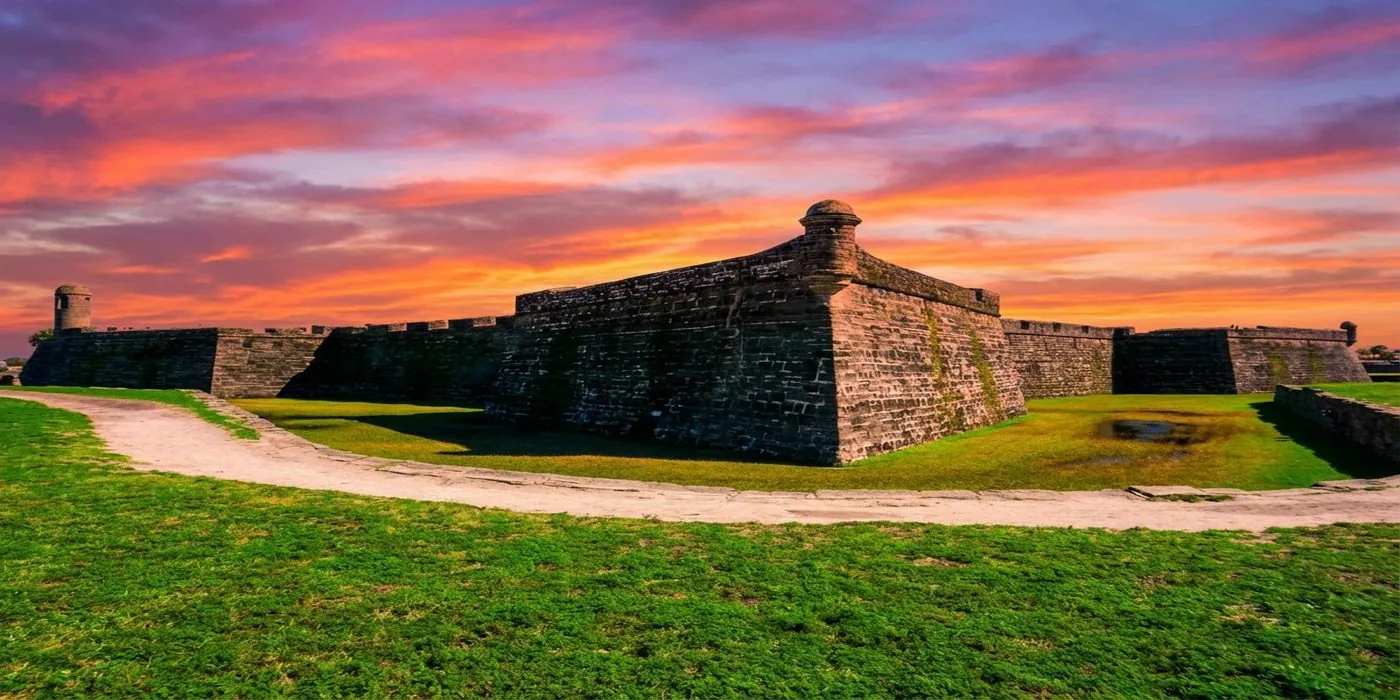
The year was 1702. The British had cannons. They had ships. They had two months and every intention of taking the fort. The walls of the Castillo de San Marcos did not cooperate. The British could not understand why. Neither, for the next three hundred years, could anyone else.
Start at the beginning.
The Spanish founded St. Augustine in 1565 — 55 years before the Pilgrims landed at Plymouth, 42 years before Jamestown. For the first century of its existence the city was defended by a series of wooden forts that burned, rotted, and fell. Nine of them in total. When English privateer Robert Searles raided the city in 1668 and the latest wooden fort proved no obstacle whatsoever, the Spanish crown finally decided it was time to build something permanent.
Construction began on October 2, 1672. It would take 23 years to complete. The workers were Native Americans from nearby missions and skilled laborers brought from Havana. The material they quarried came from Anastasia Island — the land across Matanzas Bay that is today Anastasia State Park — and was ferried across the water by hand to the construction site.
The material was called coquina. Spanish for "tiny shell." And nobody knew, not yet, what they had built with it.
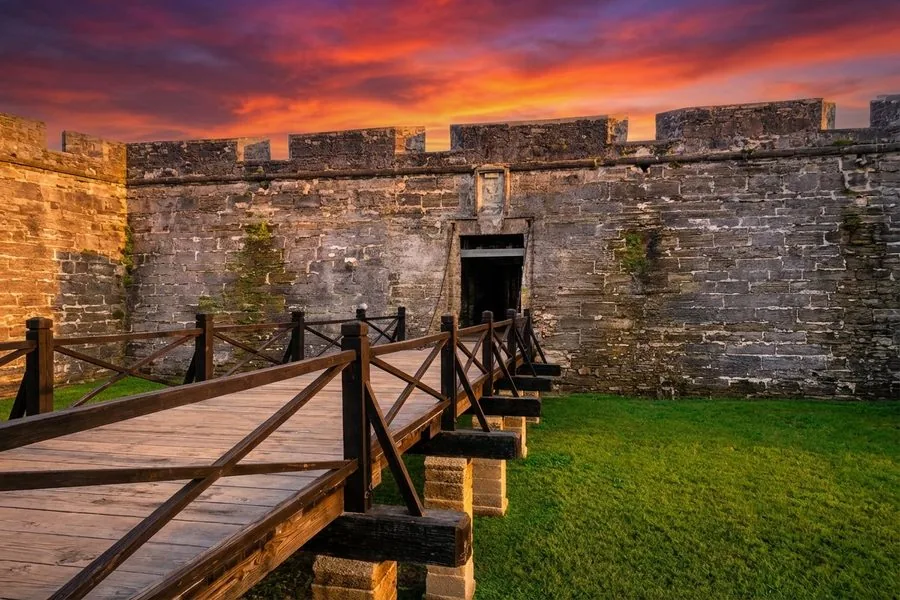
The fort was completed in 1695. Seven years later, in November 1702, Carolina's Governor James Moore arrived with an English fleet and laid siege to the city. Fifteen hundred residents and soldiers crowded inside the walls. Moore's forces took the town and fired from close range for two months straight. Cannonball after cannonball.
The walls did not crack.
They did not shatter. They did not crumble. The cannonballs did not bounce off either — they simply sank into the walls and stopped. One English soldier, staring at the damage, wrote that the stone was like firing into cheese. His cannonball went in. It stayed in. And the wall around it showed no cracks radiating outward, no fractures, no catastrophic failure of the kind he had seen in every other fort he had ever attacked.
"The rock will not splinter but will give way to cannon ball as though you would stick a knife into cheese."
— British soldier, Siege of 1702
Moore held the siege for two months. Then a Spanish fleet arrived from Havana, trapped his vessels in the bay, and the English burned their own ships to prevent their capture and marched home to Carolina on foot. The Castillo had never fallen. The Spanish repaired the walls. Life in St. Augustine resumed.
Thirty-eight years passed.
In June of 1740, General James Oglethorpe — founder of Georgia, veteran of the War of Spanish Succession, a man who had studied the 1702 failure — arrived with a British fleet of seven ships and tried again. Three hundred soldiers and 1,300 residents took shelter inside the Castillo's walls. Oglethorpe bombarded the fort for 27 days.
The walls absorbed every shot.
Morning after morning, Oglethorpe's men would train their spyglasses on the Castillo and look for damage. And morning after morning, the walls appeared untouched. Not merely repaired. Untouched. As though the cannonballs had never arrived. As though the stone itself was healing.
What Oglethorpe did not know — what no one outside the fort knew — was that the Spanish garrison was working through the night. Every evening, after the day's bombardment ended, Spanish soldiers climbed the walls with buckets of plaster and filled every hole the cannonballs had left. Then they painted over the repair with the same white lime wash that covered the rest of the fort. By dawn there was no evidence a single shot had landed.
The British stared through their spyglasses every morning at walls that looked exactly as they had the morning before. They began to whisper that the fort was healing itself. They were not entirely wrong about the effect. Only about the cause.
It was psychological warfare in an era that did not have a name for it yet. Oglethorpe's men spent 27 days watching what appeared to be a fort impervious to damage. Their supplies ran low. Their morale collapsed. Oglethorpe retreated north and never returned. The Castillo had survived its second major siege without a single wall giving way.
The question that nobody could answer — not in 1702, not in 1740, not for the following 275 years — was why. What was coquina, exactly, that made it behave this way? Every other fort built from hard stone cracked under cannon fire. Cannonballs hit granite and the impact radiated outward in fractures that split walls apart. The Castillo absorbed the same impacts and showed no cracks at all. The stone seemed to violate the basic physics of how solid objects fail under stress.
The answer came in 2015, when a team of material scientists from the University of Florida and the U.S. Army Research Laboratory finally studied coquina under laboratory conditions. What they found was that coquina is not, in the traditional sense, a hard material. It is compressed ancient shells — layers of marine organisms deposited over millennia, loosely bonded together. Highly porous. Surprisingly soft. When a cannonball strikes it, the shells at the point of impact crush — but the surrounding material simply reshuffles to make space for the projectile. There are no radiating cracks because there is no rigid structure to crack. The ball decelerates progressively, like pushing into foam, and stops several inches deep in the wall.
The fort defeated 300 years of attackers not because it was harder than what they fired at it. It defeated them because it was softer. While every other fort in the Americas was built from stone that shattered, the Spanish — possibly by accident, possibly by local knowledge — had built theirs from compressed shells that behaved like a natural sponge. The walls are 12 to 19 feet thick on the harbor-facing side. Thick enough that even a cannonball sinking several inches in had a very long way to go before it got through.
The Castillo de San Marcos was attacked by the British in 1702 and again in 1740. It was besieged, shelled, bombarded, and blockaded across 300 years of colonial conflict. It was never taken by force. Not once. Not by anyone.
The Spanish who built it thought they were using the only stone available in northeast Florida. They were correct. What they did not fully understand was that this particular stone — coquina, compressed ancient shells from the beaches of Anastasia Island — happened to be the single best material on earth for absorbing cannon fire. It would take scientists from the U.S. Army Research Laboratory 320 years after the first cannonball hit those walls to prove exactly why.
You can still see the cannonball holes in the outer walls today. There are no cracks radiating from them. There never were. The walls did not heal themselves. They simply never broke.
There is only one other fort in the world built from coquina. Fort Matanzas, 14 miles south of St. Augustine, completed in 1742. You can visit both on the same day.
Good day.
The Castillo de San Marcos is at 1 South Castillo Drive, St. Augustine. Open daily 9 AM–5 PM. Admission $15 adults, valid for 7 days. Cannon firings Friday–Sunday. The cannonball holes are on the north wall facing the street — look for the circular depressions with no cracks around them.